


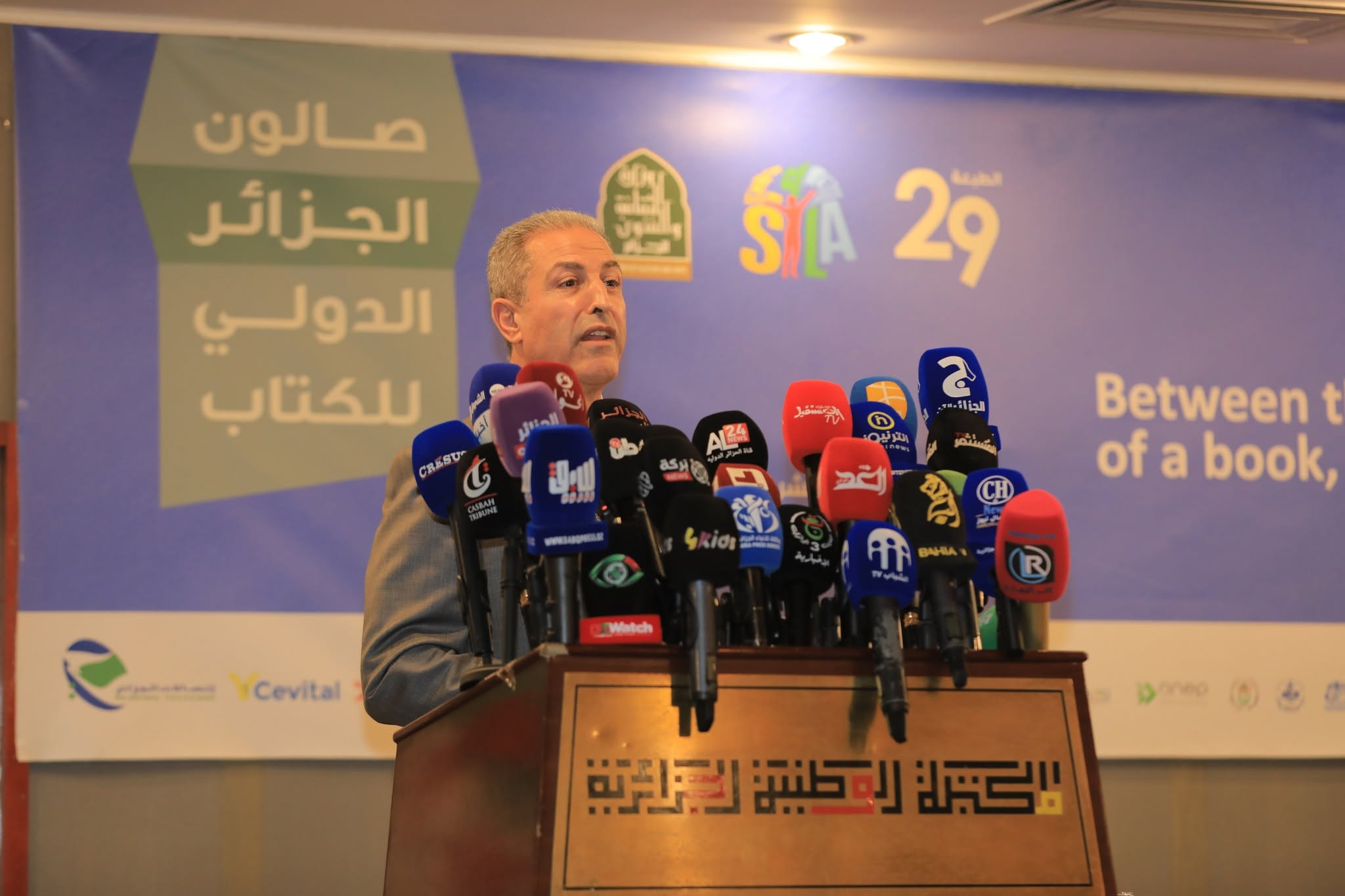
Mohamed Iguerb, Commissioner of the Algiers International Book Fair (SILA), discusses the ambitions behind this major cultural event, which is set to break records with 1,567 publishing houses from 51 countries and a programme featuring nearly 1,000 activities. He outlines the new features of the 29th edition, its main themes, and the importance of historical memory, the transmission of knowledge and cultural dialogue.
SILA 2026 is expected to be a record-breaking edition, with an impressive turnout, exhibition space that has almost doubled and a particularly extensive programme. What are the key figures for this 29th edition?
First and foremost, it is important to remember that, as a major public event, SILA is one of the most significant cultural gatherings in Algeria and internationally. It is an essential fixture on the cultural calendar, consistently ranking alongside the world’s leading book fairs in terms of visitor numbers, exhibition space and the number of publishers taking part.
Indeed, all records will be broken at this year’s edition. For the first time, the new “Palestine” pavilion has been brought into use, considerably expanding the exhibition space and bringing the total area of the Fair to 45,500 square metres, compared with 23,000 square metres at the previous edition.
This expansion makes it possible to accommodate nearly 300,000 books covering a wide range of fields, including literature, history, philosophy and science. It has also enabled us to welcome a record 1,567 publishing houses representing 51 countries.
All these figures reflect the position the Fair now occupies and the confidence placed in it by professionals from the book and publishing industries, both nationally and internationally.
The Gourara Pavilion will host “History and Memory”, an immersive experience using projection mapping technology. What is the ambition behind this initiative?
Designed as an immersive journey through our history using projection mapping technology, this space is entirely dedicated to history and collective memory. It undoubtedly offers all SILA visitors a valuable opportunity to discover the major milestones and key figures of our country’s history.
As one of the new features of this year’s Fair, it will highlight Algeria’s millennia-old history and introduce visitors to the richness of its centuries-old heritage.
Alongside the “My First Book” Prize and the Best Stand Award, you are introducing a Best Translator Award this year…
It is actually a Translation Prize. It will be awarded to one of the finest translators of literary works, Mohamed Sari.
What inspired the choice of this year’s slogan?
This year’s slogan, “Between the Covers of a Book, the Future”, stems from a profound conviction that a book is far more than a mere source of knowledge. It is a space where awareness is shaped, where the future is imagined and where the transformations to which societies aspire begin to take form.
Between the covers of a book, human experiences are also passed on, ideas intertwine and new paths towards innovation emerge. Reading thus goes beyond the simple acquisition of knowledge to become an active contribution to imagining and building the future.
Finally, I must say that this slogan captures the spirit of the Fair, conceived as a bridge connecting the world of one individual, the writer, to the world of everyone… all humanity, to borrow the language of poets.
Saudi Arabia is this year’s Guest of Honour. What were the main considerations behind this choice?
With the Kingdom of Saudi Arabia taking part as Guest of Honour, this edition holds particular significance. This choice reflects the depth of the fraternal, historical and cultural ties that unite our two countries, both of which are firmly committed to strengthening cultural exchanges and cooperation.
From this perspective, SILA offers a privileged opportunity to celebrate Saudi Arabia’s literary and intellectual heritage, introduce visitors to the diversity of its cultural expressions and highlight its international influence, as well as the richness and dynamism of its literary creativity, sustained by the vitality of writing, publishing and translation.
The literary programme is particularly extensive. Which prominent writers, thinkers and intellectual figures are expected to attend?
Broadly speaking, this year’s rich and varied cultural programme includes 994 cultural and intellectual activities. These include book-signing sessions and activities designed for children and young people.
The programme also features 61 literary and intellectual events bringing together 220 writers and thinkers from Algeria, the Arab world, Africa, Europe and the Americas.
This programme provides a valuable opportunity for writers, thinkers and intellectuals from different backgrounds to exchange perspectives and engage in discussions, thereby enriching cultural debate. It also allows the public to discover new literary experiences and fresh perspectives in the fields of knowledge and learning.
Furthermore, to answer your question more specifically, this edition will be marked, in literary terms, by a celebration of the novel and the short story.
We will explore the importance of the novel in readers’ everyday lives, while also highlighting the short story and its significance. In my view, the decision to focus on the short story stems from the fact that it remains a relatively neglected genre in literary studies.
We will also pay tribute to Kateb Yacine and commemorate the 70th anniversary of the publication of his landmark novel, Nedjma.
As every year, the Fair opens its doors to researchers, intellectuals, writers, poets and all the women and men who contribute to the influence of our culture in Algeria and around the world.
Among them are, to name just a few, Yasmina Khadra, Waciny Laredj, Rabia Djelti, Amin Zaoui, Ahmed Bensaada, Saïd Bouamama, Akli Tadjer, Saad El Bazai, Djassim Sehayah and many others.
As every year, history and collective memory are central to SILA. How will the discussions and tributes marking the centenary of the North African Star and honouring Emir Abdelkader be organised?
There is no doubt that the founding of the North African Star (Étoile nord-africaine) in 1926 represents a highly significant moment for every Algerian, a foundational milestone in our history.
SILA attaches particular importance to this national event. The centenary of the organisation will be commemorated through a major conference featuring renowned historians, academics and friends of Algeria, including Benjamin Stora, Christian Phéline, Hassan Remaoun and others.
As for Emir Abdelkader, the founder of the modern Algerian state, a high-level conference will be devoted to examining the foundations of his state, its institutions and the individuals who contributed to its establishment.
Algerian and American historians, including Ahmed Bouyerdene, Abed Soltana, John W. Kiser and Benjamin Brower, will explore the territorial and institutional organisation of Emir Abdelkader’s state.
The dialogue between historical memory and contemporary issues is also reflected in discussions on Algeria’s contribution to human civilisation, the current state of the world and anti-colonial struggles, particularly those of the Palestinian and Sahrawi peoples. Could you tell us more about this aspect of the programme ?
In this regard, I should point out that a major conference is scheduled to address the Algiers Appeal concerning colonial crimes in Africa.
This appeal, which forms part of the African Union’s efforts to promote justice and reparations for Africans, represents an important legal and historical reference at the continental level.
With its adoption by the African Union, which has designated 30 November as the African Day of Tribute to African Martyrs and Victims of the Transatlantic Slave Trade, Colonialism and Apartheid, the Algiers Appeal marks a significant step forward in efforts to recognise and criminalise colonial crimes.
Furthermore, given that SILA has always been a forum where just causes are given a voice, the Palestinian and Sahrawi questions will be addressed at high-level conferences.
The resistance struggles of our Palestinian and Sahrawi brothers and sisters will be explored through the lens of literature as a form of resistance.
Beyond the aspects I have just mentioned, I would also like to emphasise the importance attached to Algeria’s contribution to human civilisation.
This dimension will be the subject of a major conference highlighting the deep attachment of Algerians to their millennia-old history, their territory and its integrity.
The children’s area occupies an important place in the Fair’s programme. How will it be organised?
As at every edition, a substantial space has been set aside for children, covering an area of 850 square metres.
A rich and varied programme of activities has been planned, including educational workshops, reading sessions, drawing activities, educational games and, of course, storytelling.