


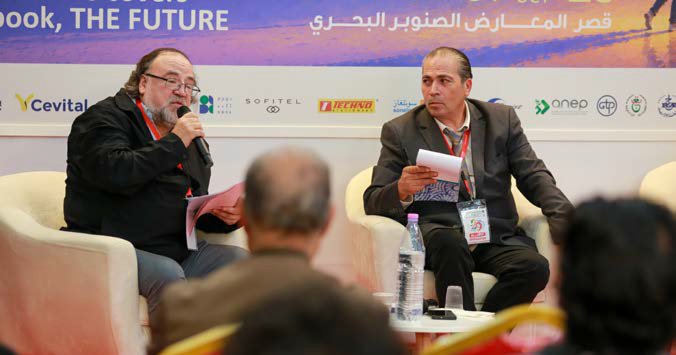
At the 29th Algiers International Book Fair (SILA), a conference entitled “The Algiers Appeal, the Voice of Humanity” brought together Algerian and international intellectuals to examine the enduring legacy of colonialism and the growing demands for historical recognition, justice and reparations. The discussions highlighted Algeria’s longstanding role in the struggle for liberation and its renewed commitment to a more equitable international order.
Bringing together sociologist and political analyst Saïd Bouamama, historian and author Hosni Kitouni, and Chilean political analyst Esteban Silva, the conference, moderated by El Zine Cherfaoui, explored the historical significance of the Algiers Appeal and its implications for Africa and the wider Global South.
At the heart of the discussions was a shared conviction: political independence has not erased the economic, social and cultural consequences of centuries of colonial domination.
Beyond Political Independence
For Saïd Bouamama, the significance of the Algiers Appeal lies in its continental scope and its understanding of colonialism as a global system whose consequences continue to shape international relations.
“The Algiers Appeal is not simply a declaration of principles without consequences,” he stressed.
According to Bouamama, the initiative marks an important shift in African political thinking by addressing not only the immediate destruction caused by colonial rule but also its lasting structural effects.
He argued that colonialism had contributed to dividing the world into dominant centres and dependent peripheries, a pattern still reflected in international economic relations.
One of the Appeal’s most significant proposals, he explained, is a continent-wide audit to assess colonialism’s enduring consequences, including its impact on debt, economic development and the environment.
Bouamama also emphasised the importance of examining slavery, colonialism and apartheid as interconnected systems of domination. In an international environment increasingly shaped by multipolarity, he believes the Appeal offers a new direction for nations seeking genuine sovereignty.
He drew a parallel with Algeria’s November 1954 Revolution, whose influence helped inspire liberation movements across Africa.
Reparations and Moral Responsibility
Historian Hosni Kitouni approached the question through the different forms of colonial domination experienced by African societies.
He recalled that many African countries emerged from colonial rule economically weakened, their resources exploited and their social structures profoundly disrupted.
Algeria, however, experienced settler colonialism, which involved not only economic exploitation but also land dispossession, social exclusion and the attempted transformation of indigenous society.
For Kitouni, this historical experience explains why moral and ethical recognition remains central to Algeria’s demands.
“We are not asking for material or financial reparations. We are asking for ethical and moral reparations,” he declared.
He argued that acknowledging the destruction of human lives, cultural heritage and social structures is essential to historical justice.
The Algiers Appeal, he added, represents an important step towards recognising colonialism as a crime against humanity, moving the debate beyond economic compensation to questions of historical responsibility and human dignity.
Algeria’s Revolution, a Universal Legacy
Chilean political analyst Esteban Silva placed the Appeal within the broader history of international solidarity and anti-colonial struggles.
A member of the executive bureau of the International Association of Friends of the Algerian Revolution, Silva described Algeria as a universal symbol of resistance and liberation.
Speaking on the eve of the 72nd anniversary of the outbreak of Algeria’s November 1954 Revolution, he paid tribute to the freedom fighters and martyrs who secured the country’s independence.
He also recalled the violence of French colonial rule, including the massacres of May 1945, the repression of Algerian demonstrators in Paris on 17 October 1961, and the lasting consequences of French nuclear testing in the Sahara.
Referring to Frantz Fanon, Silva argued that defending the Revolution’s legacy today means continuing the struggle for justice, sovereignty and self-determination.
He highlighted the historical solidarity between Algeria and Chile, particularly under Presidents Houari Boumediene and Salvador Allende, recalling Algeria’s support for Chilean political refugees following the 1973 military coup.
For Silva, this relationship illustrates Algeria’s enduring internationalist tradition, also reflected in the 1973 Non-Aligned Movement summit in Algiers and the campaign for a New International Economic Order.
From Remembrance to Justice
The speakers also examined the significance of the Algiers Appeal adopted following the international conference held on 30 November and 1 December 2025.
Its subsequent recognition within the African Union’s agenda was presented as a step towards a collective African approach to colonial crimes, historical memory and reparative justice.
Silva stressed that the transition from political condemnation to legal accountability remains a long-term undertaking.
The conference also addressed contemporary forms of dependency, including international debt, unequal trade relations, technological control and competition over strategic resources.
Throughout the discussions, one central message emerged: colonialism is not merely a chapter of history. Its legacy continues to influence global inequalities and the struggle for national sovereignty.
By hosting this debate, SILA 2026 reaffirmed Algiers’ historic place as a meeting point for ideas, solidarity and the universal aspiration to freedom and justice.