


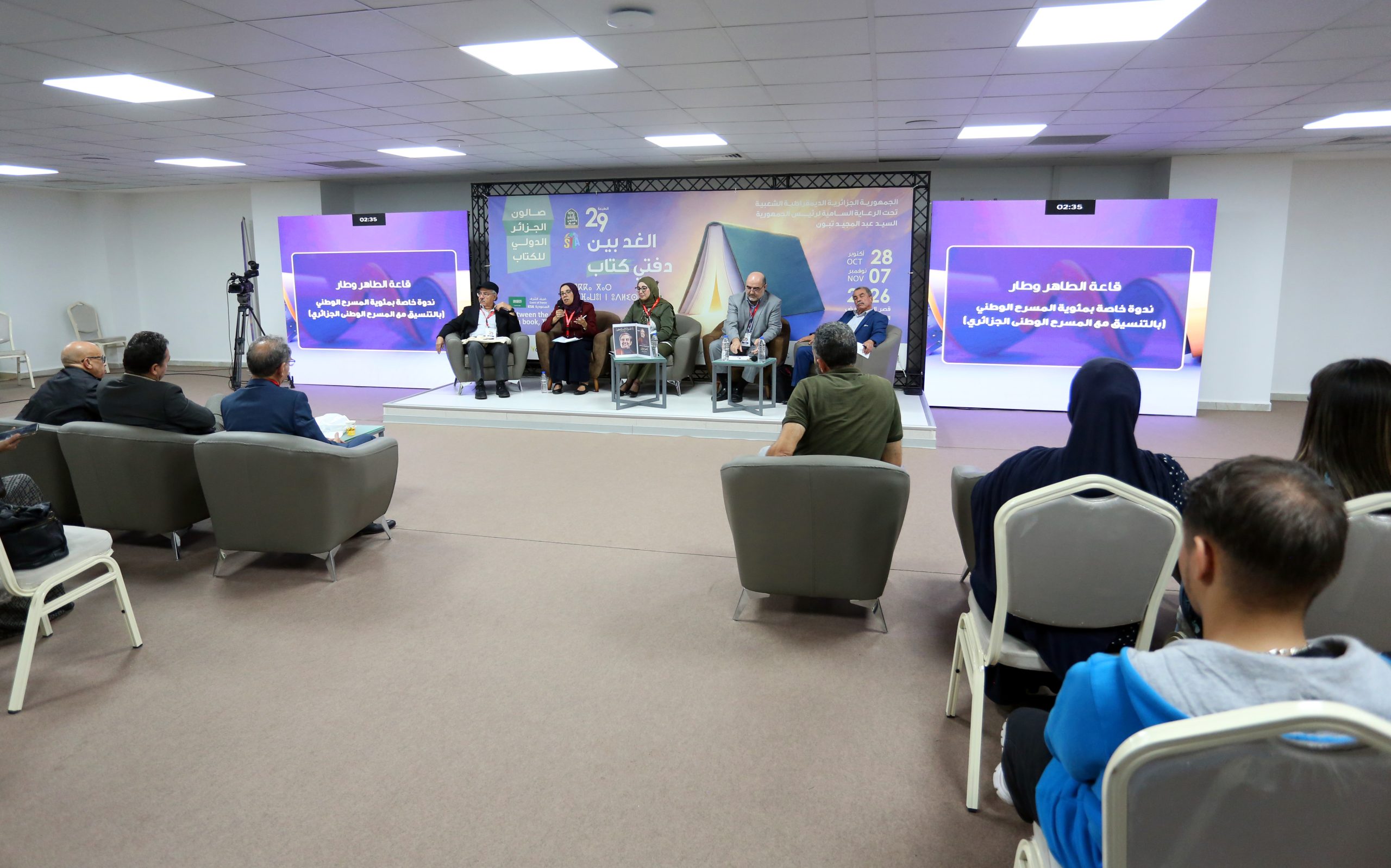
The Tahar Ouettar Hall at the 29th Algiers International Book Fair (SILA) hosted a conference marking the centenary of Algerian theatre. Bringing together academics, critics and artists, the event offered an opportunity to revisit the history of the performing arts in Algeria while raising a fundamental question: can the birth of Algerian theatre truly be dated to 1926, when the country already possessed a rich heritage of traditional performance practices long before that year? Speakers called for a reassessment of historical narratives inherited from the colonial period and greater recognition of the popular forms of artistic expression that preceded the emergence of modern theatre.
A Theatrical Heritage Dating Back Before 1926
Academic and artist Azri Gouti argued that the roots of Algerian theatre extend far beyond 1926. He stressed the need for an epistemological break with colonial historiography, which tended to trace the beginnings of theatre in Algeria to the emergence of modern stage performances in the nineteenth century. He recalled that Algerian society had long developed its own forms of public performance, including the halqa (traditional storytelling circle), the goual (oral storyteller) and the maddah (traditional performer and reciter), particularly in public spaces and rural communities. These oral traditions later inspired leading figures of modern Algerian theatre, including Ould Abderrahmane Kaki, Abdelkader Alloula and Mahieddine Bachtarzi. To illustrate his argument, Gouti drew a parallel with Italy’s commedia dell’arte, which flourished for nearly two centuries without relying on a systematically written repertoire. He questioned why Algeria’s traditional performance practices had not received similar historical recognition and called for further anthropological research into this cultural heritage.
From Popular Performance to a Theatre of Resistance
Researcher Djamila Mustapha Zeggai offered a historical overview of the major stages in the development of Algerian theatre, describing the centenary as an opportunity to critically assess a century of artistic creation and accumulated experience. She recalled that the first structured theatrical initiatives, between 1921 and 1939, were largely promoted by cultural associations and initially favoured classical Arabic. The year 1926, however, marked a significant turning point with Djeha, a play by Allalou (Ali Sellali), which brought Algerian colloquial Arabic to the stage and helped theatre reach a broader audience. This period also saw he emergence of major figures such as Rachid Ksentini, often described as the « Algerian Molière », Mahieddine Bachtarzi and Mohamed Touri. With the outbreak of the Algerian War of Independence in November 1954, theatre gradually acquired a new political and militant dimension. Under the leadership of the National Liberation Front’s (FLN) artistic troupe, notably through the work of Mustapha Kateb, theatre became a means of mobilisation and a vehicle for raising international awareness of Algeria’s struggle for independence. Performances staged abroad helped bring the Algerian people’s fight for freedom to international audiences. Following independence in 1962, the nationalisation of theatre and the establishment of cultural institutions ushered in a new era. The 1970s and 1980s were particularly marked by a renewed interest in cultural authenticity and popular traditions, reflected in the works of playwrights such as Ould Abderrahmane Kaki, Kateb Yacine and Rouiched.
Rewriting History Through the Archives
Azzouz Benamar, a researcher at the University of Oran, raised a central question: « Are we celebrating one hundred years of theatre, or one hundred years of searching for Algerian theatre? And after a century, have we achieved our goal? » He highlighted the difficulties historians face because of the shortage of documents and theatrical texts needed to reconstruct the development of Algerian theatre accurately. Questioning the sources traditionally used to write this history, he referred to the work of Ibn Cheneb, accounts published in the French press and reports produced by colonial censorship authorities. According to Benamar, French colonial police archives still contain valuable information about the earliest generations of Algerian theatre artists and their resistance to colonial domination. A more thorough examination of these records, he argued, could significantly enrich and reshape our understanding of this period.
A Tribute to Sid Ahmed Agoumi
The conference also paid tribute to Sid Ahmed Agoumi, a prominent figure in Algerian theatre and cinema who recently passed away. Abdelhamid Rabia revisited the career of the artist, born in 1940 in the Casbah of Algiers, highlighting his early involvement in school theatre in Ben Aknoun, his participation in the FLN artistic troupe and his remarkable artistic journey. An actor, director, translator and critic fluent in both Arabic and French, Agoumi left a lasting mark on Algerian theatre, cinema and television through his extensive body of work. At the conclusion of the conference, participants stressed that the centenary of Algerian theatre should not be limited to a symbolic commemoration. Instead, it should serve as a starting point for more extensive research, documentation and a critical reassessment of the country’s theatrical history. Exploring national and international archives, alongside the collection and preservation of oral traditions, was considered essential to restoring the full depth of a theatrical heritage whose origins extend well beyond the conventional historical milestone of 1926.