


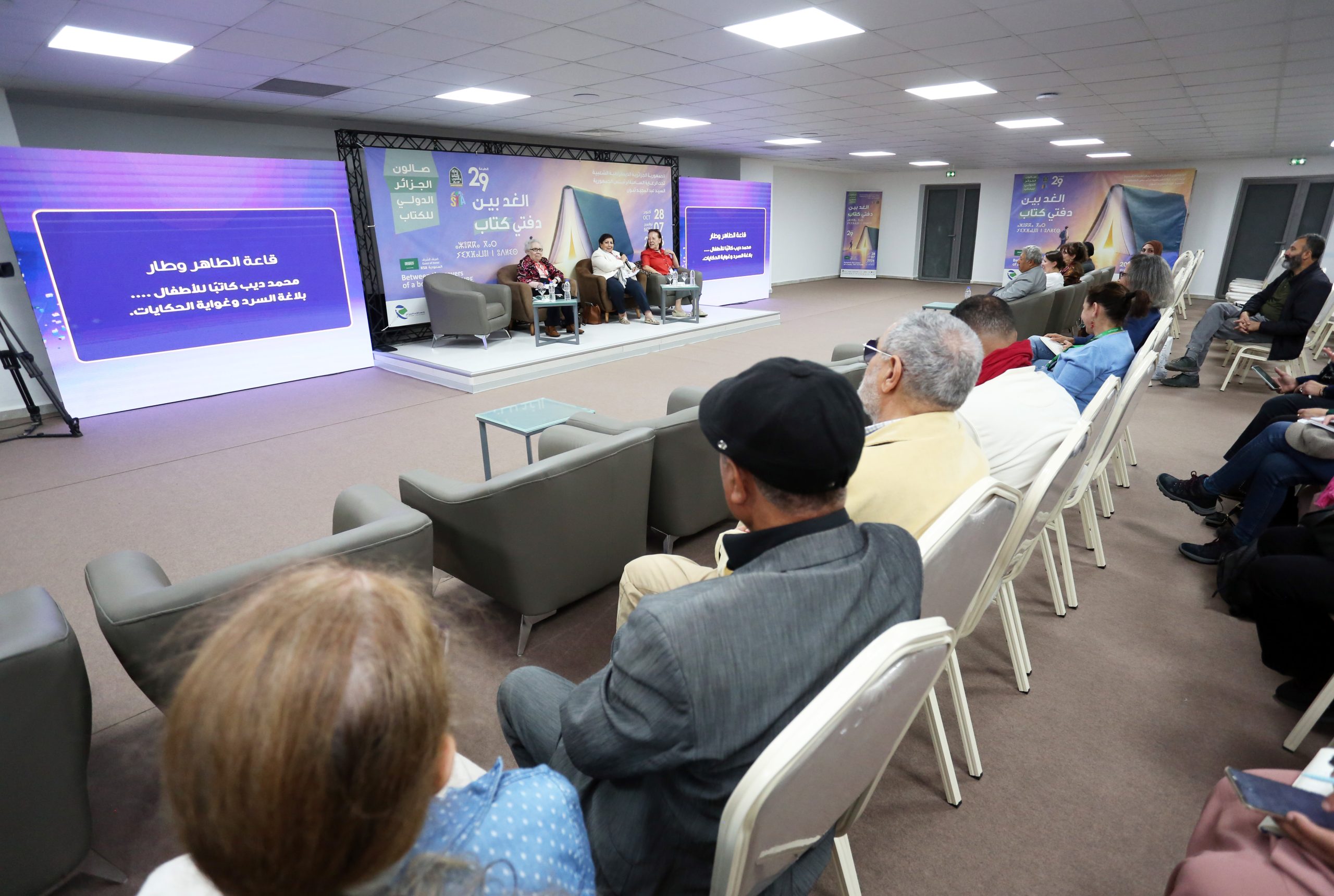
The Tahar Ouettar Hall at the Algiers International Book Fair (SILA) hosted a discussion on Thursday, November 5, entitled “Mohammed Dib, a Writer for Children: The Eloquence of Storytelling and the Appeal of Fairy Tales.” Bringing together Catherine Naïma Dib, the writer’s daughter, and academic Naget Khadda, the event shed light on a relatively little-known aspect of the celebrated Algerian author’s work: his writing for children.
Catherine Naïma Dib began by praising the efforts of Algerian publishers to keep her father’s literary legacy alive and introduce his work to new audiences, particularly through publication and translation.
Approaching his stories from a distinctive perspective, she placed them within a long tradition of wisdom tales and the transmission of knowledge, whose origins, she suggested, could be traced back to the teachings of ancient Egypt. Intended to pass on values of balance, respect and integrity to younger generations, such narratives have travelled across centuries and civilizations, influencing Eastern storytelling traditions and European fables alike.
For her, her father’s tales embody precisely this tradition of wisdom, expressed through writing of exceptional refinement.
“What struck me most was this remarkable literary sophistication. The text is a genuine work of writing. Mohammed Dib did not approach it as an ethnologist or linguist travelling from village to village, recording what he heard. This is his own writing, writing of extraordinary clarity,” she explained.
That clarity, she argued, allows children to enter the stories naturally, without being burdened by an overtly moralizing message. “The moral is never explicitly stated; it is left for the reader to discover,” she observed.
She also emphasized the writer’s determination to keep violence out of his stories for young readers, in contrast to certain Western fairy tales populated by ogres, abandoned children and frightening characters.
“These stories are rooted in thousands of years of wisdom-tale traditions, yet they speak to children today. They are characterized by gentleness, elegant language, universal values and humanism,” she explained, arguing that their appeal extends far beyond their North African origins.
In her view, Dib’s writing for children may also reflect a desire to restore a tenderness that was largely absent from the childhood portrayed in his earliest works.
“I have the impression that, through the magic of writing and poetry, he was able to bring back a gentleness that had not existed in his own time,” she suggested.
A Literary Work Open to Multiple Interpretations
Academic Naget Khadda, for her part, examined Mohammed Dib’s writing in the broader historical, cultural and identity-related context of his time.
Highlighting the richness of a body of work that lends itself to multiple interpretations, she noted that “entering Dib’s literary universe means passing through many doors, each one opening onto another.”
His writing, she argued, offers insights not only into the literary production of his contemporaries but also into the profound transformations of Algerian society.
Reflecting on the 1950s, Khadda recalled the dilemma facing Algerian writers who expressed themselves in French while seeking to affirm their cultural identity through the language of the colonizer.
“There is a genuine issue here involving psychoanalysis, sociology and history,” she explained, pointing to the difficulty of expressing one’s cultural belonging through a language shaped by a different historical experience.
In this respect, she argued, Mohammed Dib succeeded in transforming the French language into a powerful vehicle for expressing Algerian identity.
She described a literary approach that brought together the culture acquired through formal education and the traditions inherited from his native environment, creating a distinctive synthesis.
“Dib possesses the remarkable ability to express Algerian identity through the most elegant, purest and most refined French,” she emphasized.