


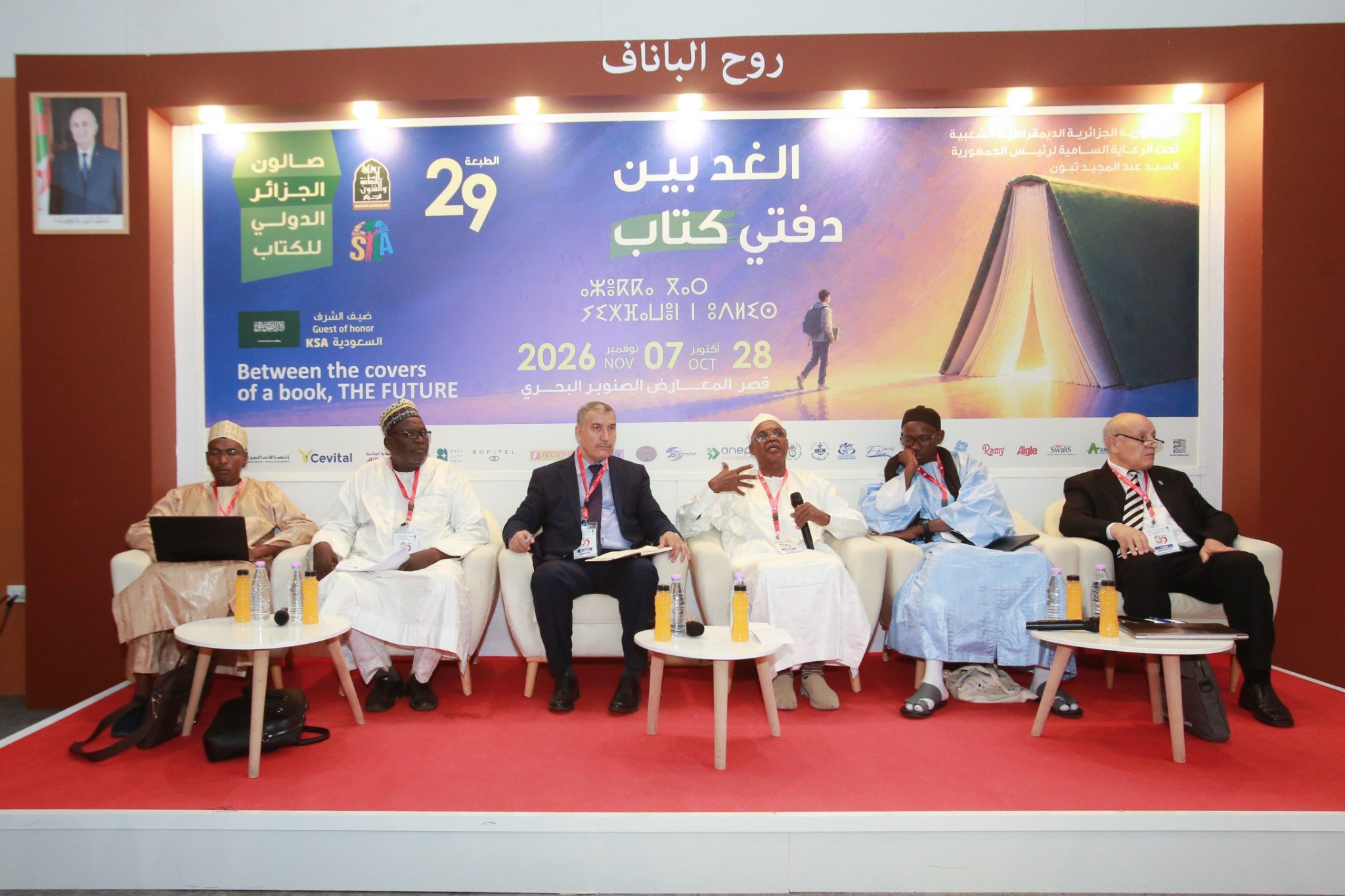
The Sahara was never simply a barrier separating peoples, but a vast crossroads of knowledge, languages and cultures. This was the central message of five African scholars who gathered at the Algiers International Book Fair (SILA 2026) for a conference entitled “Algerian-African Manuscripts: Linguistic Interconnections and a Shared Sense of Belonging.”
Moderated by researcher Lakhmici Bazzaz, the conference brought together Abdelkrim Aoufi (Algeria), Mohamed Salah Ayoub (Chad), Salou El Hassan (Niger), Sam Bousso Abderrahmane (Senegal) and Adam Bello (Nigeria). Through their presentations, the speakers explored the intellectual and spiritual ties forged over centuries between Algerian cities and major African centres of learning. For Abdelkrim Aoufi, a professor at the University of Batna, a manuscript is far more than an ancient document. It is a repository of the scientific and cultural memory of peoples.
“The Sahara is a dynamic bridge of knowledge, not a geographical barrier,” he emphasized, recalling the role played by Tlemcen, Touat, Ouargla, Biskra and other Algerian centres in transmitting knowledge to Timbuktu, Agadez, Kano and Sokoto. As he explained, this exchange took place through trading caravans, scholarly journeys, educational institutions and Sufi brotherhoods. The works carried along these routes were subsequently copied, annotated, translated and enriched by African scholars, giving rise to original intellectual traditions.
Algerian Manuscripts at the Heart of African Libraries
Chadian scholar Mohamed Salah Ayoub, a professor at the University of N’Djamena, presented the findings of fieldwork conducted in Abéché, the former capital of the Wadai Sultanate. He identified four major collections containing more than 130 manuscripts and approximately 2,672 folios. These documents provide evidence of the spread of the Maliki school of Islamic jurisprudence, Ash’ari theology and the Tijaniyya Sufi order, whose historical roots lie in Aïn Madhi, Algeria.
The researcher also highlighted correspondence and genealogical records attesting to the enduring spiritual and cultural relationships between Chadian and Algerian religious families. For his part, Salou El Hassan, a lecturer at Abdou Moumouni University in Niamey, emphasized the importance of the manuscript collection held by Niger’s Institute for Research in Human Sciences, which preserves more than 4,000 manuscripts.
Among these are works by Algerian scholars such as Al-Akhdari, Al-Sanussi and Al-Maghili. He cited, in particular, Al-Akhdari’s treatise on Islamic jurisprudence, written in Biskra, whose texts were copied, commented upon and translated into Fulfulde, the Fulani language.
For the Nigerien researcher, these adaptations demonstrate that African societies did not merely receive knowledge from elsewhere. They actively assimilated it, interpreted it and incorporated it into their own intellectual traditions.
A Living Legacy in African Education
This educational dimension was further explored by Sam Bousso Abderrahmane, a Senegalese researcher at Cheikh Ahmadou Bamba University. He explained how the writings of Algerian scholars became essential references in Senegal’s traditional schools. He particularly highlighted the contribution of Sheikh Ahmadou Bamba, founder of the Mouride Sufi brotherhood, who transformed several theological and jurisprudential treatises into poetry to make them easier to understand and memorize.
Nigerian researcher Adam Bello, Director of the Sultan Muhammad Bello Centre for Islamic Heritage and African Studies, examined the influence of Algerian manuscripts on the Sokoto Caliphate. He placed particular emphasis on the writings of Al-Sanussi and Al-Maghili, whose works shaped religious education and reflections on governance. He also recalled their influence on the reformer Usman dan Fodio and the scholars of his era.
Beyond these intellectual traditions, the speakers highlighted the importance of Ajami writing, which uses Arabic script to transcribe several African languages, including Fulfulde and Hausa. This tradition illustrates the linguistic diversity of a shared cultural heritage and the ways in which African societies adapted written knowledge to their own languages.
The conference also drew attention to the urgent need to preserve manuscript collections, many of which remain little known or insufficiently studied. Salou El Hassan notably called for joint cataloguing initiatives, the digitization of collections and the training of specialists in manuscript conservation and restoration. These proposals aim to transform this manuscript heritage, a testament to centuries of shared history, into a living instrument of scientific and cultural cooperation between Algeria and other African countries.