


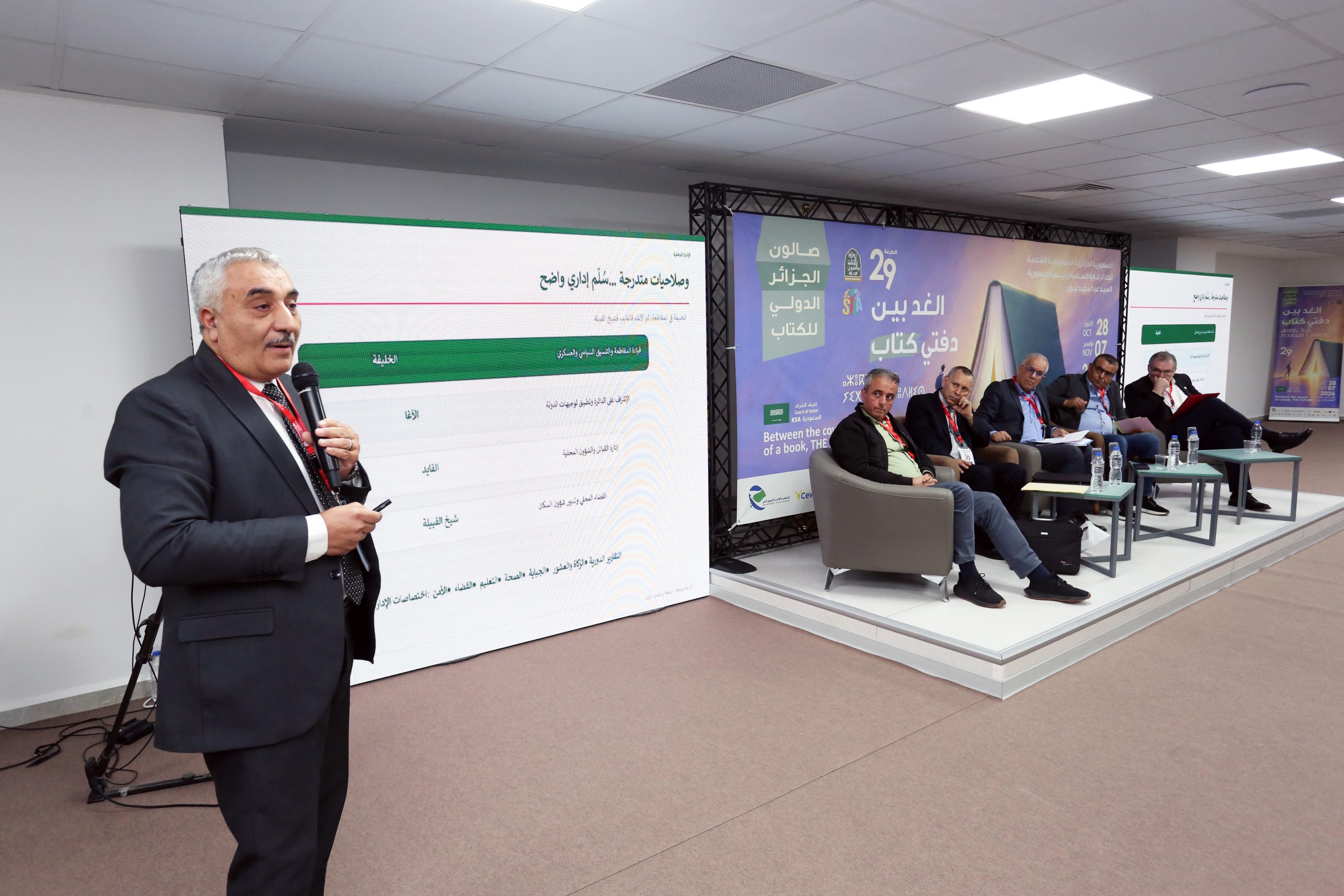
The conference entitled « The State of Emir Abdelkader: Institutions and Leadership », held at the Algiers International Book Fair (SILA), explored the political legacy of a historical figure whose achievements extended far beyond military resistance. Scholars examined his efforts to establish institutions, appoint capable officials and develop a system of governance rooted in legitimacy and justice. They also highlighted the spiritual foundations of his leadership and his influence beyond Algeria’s borders.
Laying the Foundations of a State
Emir Abdelkader was not merely a military leader who organised resistance against French colonial rule. He was also a statesman determined to establish a solid political structure despite the challenges and upheavals of his time.
Ouddène Boughoufala emphasised the importance of the bay’ah (pledge of allegiance), which, he argued, laid the foundations for the legitimacy of Abdelkader’s state. This process went beyond tribal alliances, reflecting a broader national project aimed at bringing different segments of society together under a common authority.
As the state developed, it established institutions and a structured territorial administration. Foreign affairs, economic management, and both civil and military justice were among the areas placed under its authority.
The appointment of officials was also guided by specific criteria, including competence, integrity and commitment. Boughoufala nevertheless pointed out that the process of state-building encountered local resistance, particularly from influential figures who feared losing their privileges.
Political Leadership Guided by Spiritual Values
The speakers also highlighted the importance of moral principles in Emir Abdelkader’s leadership, particularly in the conduct of warfare.
American historian Benjamin Brower examined how Abdelkader was portrayed in the nineteenth-century American press, where he was sometimes compared to Napoleon. According to Brower, such comparisons failed to capture the full complexity of a figure who was simultaneously a military commander, political leader and thinker.
He recalled that the Emir sought to uphold rules governing warfare, notably prohibiting attacks on civilians and the mistreatment of prisoners.
Ahmed Bouyerdene, for his part, stressed that Emir Abdelkader could not be understood solely through his military achievements. His political decisions and actions also had to be considered in light of his spiritual convictions and the Prophetic tradition.
His intervention in Damascus, Syria, in 1860, when he protected Christians threatened by violence, illustrated his commitment to defending human life and protecting innocent people regardless of their origins or religious beliefs.
Abdelouahab Belgherras explored the spiritual dimension of the Smala, the Emir’s mobile administrative and military capital. He drew particular attention to its arrangement in concentric circles and the central position of the Emir’s tent, which, in his interpretation, reflected the close relationship between political authority and a spiritual vision of leadership.
Taken together, the presentations demonstrated that Emir Abdelkader’s legacy extends well beyond his resistance to French colonial rule. His political journey also represented a significant experiment in state-building, based on institutions, territorial organisation and principles of governance whose historical significance transcends the battlefield.