


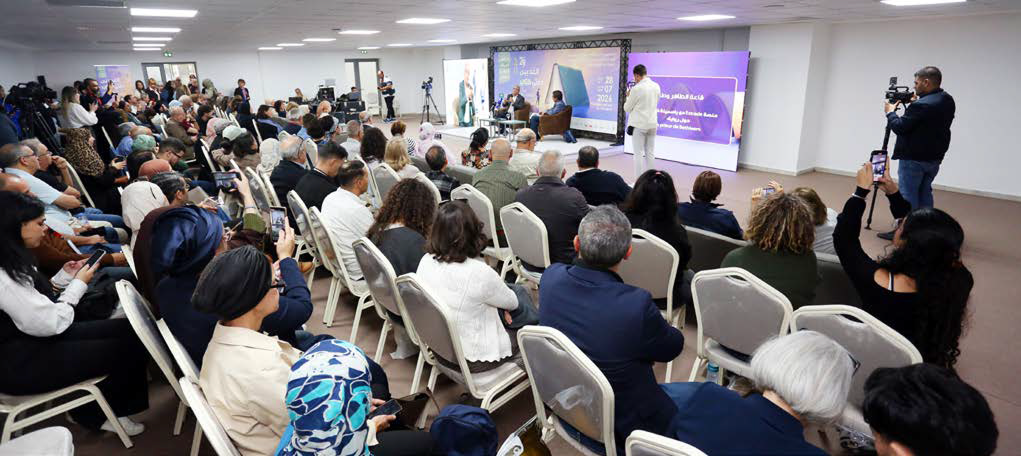
Algerian novelist Yasmina Khadra took part in a literary event on Tuesday, November 3, at the Tahar Ouettar Hall of the Algiers International Book Fair (SILA), as part of the cultural programme of its 29th edition. The acclaimed author discussed his latest novel, Le Prieur de Bethléem (The Prior of Bethlehem), published in Algeria by Casbah Editions, reflecting on the literary choices behind the work, its symbolic significance and his response to the Palestinian tragedy. The event also provided an opportunity for the writer to offer an uncompromising assessment of the state of the world, the international community’s silence and the responsibility of intellectuals in the face of human suffering.
Literature in the Face of the Palestinian Tragedy
The author of The Attack explained that writing his latest novel required finding a literary form capable of conveying the gravity of its subject. “To speak about Palestine today, I needed something simpler, something that could express what the human conscience will never be able to bear,” he said, before condemning what he described as a profoundly sick world, marked by cowardice. “Palestine has proved that the world is a false world, a degenerate world, a sick world, a cowardly world,” he declared. Khadra also addressed the ideological dimension of his novel, particularly his criticism of Zionism and its manifestations. “I wanted to return to this ideology that leads people to believe they are chosen, superior, that they belong to a nation apart. Yet their actions prove that they are not only ordinary, but even rather pathetic,” he said.
For the novelist, the book sought to expose the contradiction between claims of superiority and the reality of the actions committed.
He also noted that his latest novel had been translated in only five countries, lamenting what he considered a lack of intellectual courage among certain publishers around the world. Reflecting on the writing process, Khadra explained that he had sought a style capable of conveying the full weight of suffering and tragedy.
“When you want to address a subject, you have to find the style that suits it. I became so deeply immersed in this reality, so overwhelmed by what I had seen and felt, that I needed a form of writing equal to that suffering,” he explained.
“Where Has Our Humanity Gone?”
Above all, Yasmina Khadra insisted on the situation in Palestine and the world’s moral responsibility in the face of atrocities. Referring to the images of suffering broadcast daily, he questioned the gradual erosion of human values and the indifference shown by parts of the international community. “Today, genocide is taking place in full view of the entire world. So where has our humanity gone?” he asked. For the writer, inaction is itself a form of complicity. “I could never have accepted being complicit. Even if we do not take part in genocide, the mere fact of knowing about it and doing nothing makes us complicit,” he argued. This conviction, he believes, places a particular responsibility on intellectuals and artists, who must not turn away from the moral challenges of their time. Yet despite his severe criticism of the world’s response to the Palestinian tragedy, Yasmina Khadra refuses to surrender to pessimism. “I am an optimist. I refuse to give in to despair,” he affirmed, expressing his belief that humanity retains the capacity for resilience, even in the aftermath of the greatest catastrophes.